Blog &
Articles
Controlled Chaos: The Challenge of Estimating AI-Augmented Tasks
AI broke our math.
For a decade, our company accumulated precise data on exactly how long it takes to complete a given task: three hours to proofread the scripts for an hour-long video training course, four hours to create PowerPoint design concepts for a new client’s training materials. These benchmarks served as a valuable guide for scoping new projects.
Then generative AI arrived, and suddenly we found ourselves asking questions our spreadsheets couldn’t answer. How long should it take to create a set of graphic design concepts when AI can generate rough sketches from prompts like “try it again, but this time incorporate wood tones and natural textures”? How many hours should it take to reformat legacy documentation for complex industrial equipment when AI handles the copy-and-paste work?
I’m perhaps more obsessive about this than most. First, because our company helps clients develop and implement AI agents for workforce training and operations. Second, because – at a previous job – I worked on a healthcare cost accounting software platform that hospitals use to track time and money spent on different tasks, down to how many minutes it takes an orderly to change a patient’s bed linens. And while I’m not an accountant or a financial analyst, that experience made me the kind of manager who tracks time and money to the nearest fifteen-minute increment.
Which means watching AI render our carefully calibrated benchmarks unreliable has been… exciting, but also a bit uncomfortable.
So, how can organizations adapt to the new math of AI-augmented work? That’s still an open question, though in this article, I’ll share what we’ve learned through firsthand experience within our own company, and from clients implementing the AI systems we’ve designed. The short version: not all AI use cases are created equal, and understanding the differences is essential for anyone trying to plan and budget projects in the age of AI.
Three Layers of AI-Augmented Work
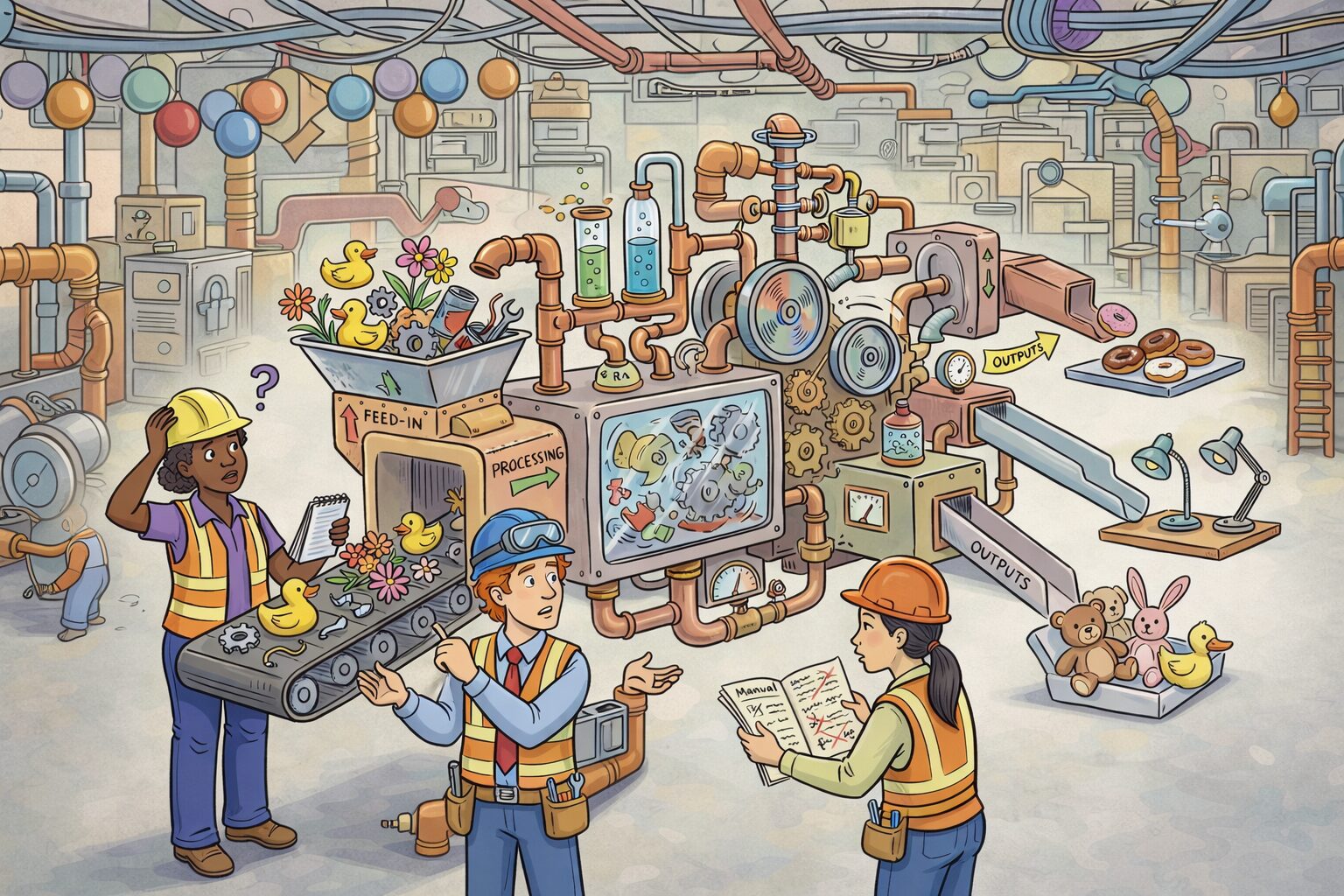
At a high level, AI-augmented work divides into three distinct layers – each with radically different implications for estimation and project management.
Layer One: Accelerating Repetitive Work
Some tasks are simply faster with AI, and the time savings are reasonably predictable.
Our team has built AI tools for clients that slashed the hours required for certain administrative and editorial tasks by 60 to 90 percent (e.g., searching the internet for disability-friendly jobs, writing professional licensure exam questions, reformatting technical documentation.)
We’ve seen similar results within our own operations. Clients sometimes hand us multiple 100+ page technical manuals as source material for training courses. Previously, we’d spend hours reviewing them page by page, only to discover that some manuals contain only half a page of relevant information, or perhaps none at all. Today, if we suspect a massive document might be largely irrelevant, we use AI to summarize each section and subsection, then spot-check the results. What used to be an exhausting full-day slog now takes about an hour.
On the software side, our workforce training platform already integrates with multiple AI model providers (OpenAI, Anthropic, Google, Perplexity, xAI, and others). When we want to add another model to the list, we’ll ask Claude Code to examine our existing integrations and create something similar for the new one. Its first pass is usually 60 to 70 percent usable. What used to take the better part of a day now takes an hour or two.
These tasks share common characteristics:
- They’re repetitive
- They involve judgment, but nothing too nuanced or complicated
- The pattern or format is already established; AI merely accelerates execution
In these cases, we feel comfortable trimming a predictable percentage off previous benchmark times when estimating projects.
Layer Two: Collaboration on Creative and Critical Thinking Tasks
Much of our work involves building AI agents that provide coaching and collaborative advice—from assisting social service agency clients with job hunting to helping financial advisors persuade high-net-worth individuals to invest with their firm. While it might seem like users are just “talking to a chatbot,” brainstorming and problem-solving with AI agents is quietly changing how knowledge workers spend their time.
Research published in Harvard Business Review estimated that knowledge workers spend 85 percent of their time attending meetings, sitting on conference calls, and writing emails—as opposed to actually doing focused work. Talking through challenges with an AI coach can deliver many of the same benefits as consulting coworkers, without the “meeting tax” on everyone’s calendar.
Meanwhile, a study from RWTH-Aachen University confirmed that AI-assisted brainstorming can be more productive than traditional methods. Researchers divided participants into three groups: interactive teams brainstorming together, individuals brainstorming alone then pooling ideas, and individuals brainstorming with AI assistance. The AI-assisted group generated 170 to 201 percent more unique, quality ideas than either alternative.
So instead of “Could this meeting have been an email?” the new question becomes “Could you have run your question past AI first?”
On our own software team, we don’t rely on AI to make big-picture architectural decisions. But we encourage team members to ask Claude any questions they have about specifications, then post the AI’s answer in a public chat channel. Managers can simply give a thumbs-up or brief clarification rather than typing up their own explanation from scratch.
If the AI system is well-designed and provides good advice, this kind of collaboration can reclaim significant time from meetings and email chains—time that can be redirected to focused work.
Layer Three: Emerging Capabilities
Some of the most exciting AI applications are ones that simply weren’t possible before, even if the technology isn’t yet fully reliable. Projects leveraging these capabilities can be thrilling to work on, but they require a fundamentally different approach to project management.
For instance, we’ve used AI to help clients create videos from still photos taken inside factories (far less expensive and disruptive than location filming) and update older training videos to cite current statistics (with the original presenter’s consent to use their likeness, of course).
We’ve developed techniques to increase success rates and clean up the output. But there’s still a random (stochastic) element. Sometimes it takes two attempts to generate consistent quality. Sometimes it takes twenty. The models cooperate or they don’t, and you won’t know which until you’re in the middle of production.
This isn’t a complaint. The fact that we can generate professional b-roll of factory operations in two hours (work that would have cost $50,000 and taken three months with a traditional video crew just a few years ago) is remarkable. But it means these projects require different estimation approaches than predictable Layer One work.
And by definition, the goalposts for emerging capabilities keep moving. Just as your process matures and your team develops reliable estimates, the underlying tools shift.
Eighteen months ago, we tried to build a safe driving simulation for the FDNY involving AI-generated images of traffic scenarios from the perspective of a fire engine driver. That attempt failed: no matter how many reference images we provided, the AI produced cars going the wrong way, bizarre lane markings, and physically impossible intersections.
We haven’t revisited that project yet. But based on the improvements we’ve seen in image generation models since then, what was impossible in late 2023 might be achievable today. The question with emerging AI capabilities isn’t just “Can we do this?” but “Can we do this *yet*?”
The Great Recalibration
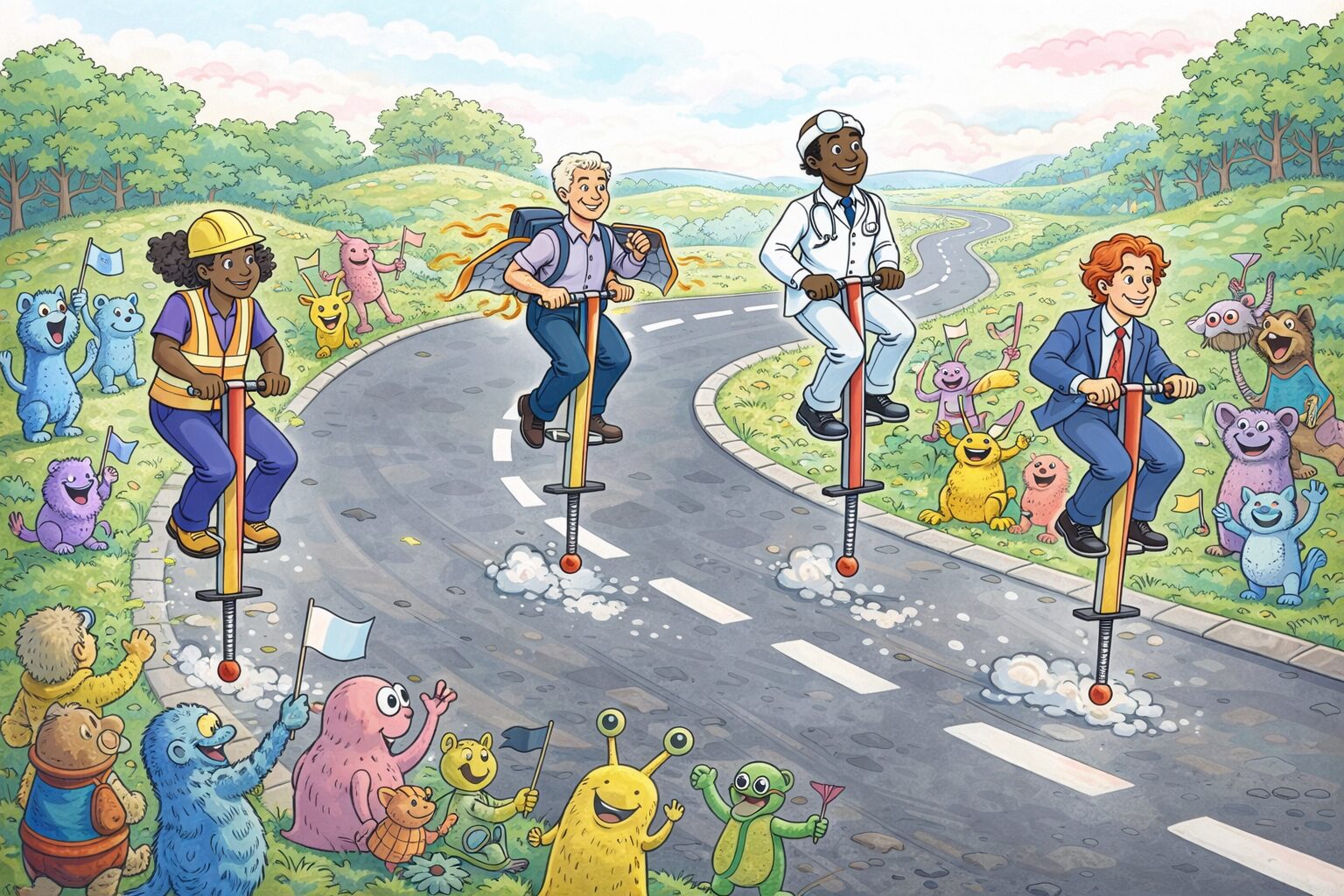
As if AI’s inherent variability weren’t enough, AI doesn’t accelerate work uniformly across your team.
We’ve had the opportunity to benchmark workforce performance before and after introducing AI assistance, both internally and with clients implementing our systems. The pattern is consistent, and it has implications that go far beyond project estimation.
Performance gains with AI tend to be U-shaped. New hires and struggling performers will see dramatic improvement. Someone who’s slow at a task is usually slow because they’re uncertain, making mistakes, iterating inefficiently. AI gives them confidence, catches errors, suggests approaches they wouldn’t have considered. The productivity gain can be enormous, as much as 80 percent or more.
At the other end, the absolute top performers are seeing performance gains of a different sort. Experts no longer have to waste time typing up minor variations of the same explanations for different audiences, and can instead focus on truly novel problems, increasing their output, or making themselves more available to those who need their guidance and support.
Then there’s the middle: people who aren’t exactly “domain experts” but rather capable functionaries. They own and have optimized a few set workflows, know the shortcuts, and rarely make mistakes. They’re already operating near the theoretical maximum for human performance. AI assistance might shave a bit of time off, but the gains might be marginal – unless the organization committed to automating those processes fully.
The result? A shorter on-ramp for new hires, more bandwidth for experts, but the middle gets squeezed.
This has profound implications beyond estimation:
- Hiring: If AI compresses the performance distribution, the premium you pay for experience in process-driven roles may no longer be justified by proportionally higher output. Does it still make sense to pay 2x for someone who’s now only 1.2x as productive as an AI-assisted average performer?
- Incentives: If AI allows your absolute top performers to do the work of an entire team or department or have an outsize impact on the organization as a whole – should that translate into massive pay increases, on the order of 2x, 5x, or more? And how do you incentivize experts to encode their knowledge into AI systems, when they may rightly suspect that will erode their competitive advantage?
- Team structure: If AI can elevate struggling performers to competence and make top experts omnipresent, do you need as many middle managers reviewing and directing junior work?
- Benchmarks: When setting new benchmarks, do you aim for the theoretical maximum productivity that AI allows, or split the difference and allow people to breathe a bit easier? This is a question not just for workplaces, but for society as a whole.
A recent study from the Federal Reserve found that, while jobs are down in AI-exposed industries, wages for experienced workers have remained stable or even risen slightly, suggesting that organizations are prepared to hold on to their experts while expecting more productivity per capita overall.
Operating With AI Uncertainty

Working with AI can be chaotic, even when it’s “creative chaos” in the positive sense. The question is how to harness that chaos while still delivering predictable results to clients and stakeholders.
Here’s what we’ve learned:
- Build contingency buffers, but make them dynamic. Don’t just pad estimates for individual tasks. Maintain a running contingency pool across projects. When AI cooperation means something finishes faster than expected, pay into the pool. When the models decide to be difficult, draw from it.
We’ve been running this approach at Parrotbox for the past several months, apportioning each project an AI contingency buffer that either gets spent or paid back to a central line item: effectively a form of “AI variability insurance” across projects.
- Formalize your AI workflows. Generic AI chatbots are fine for ad-hoc tasks, but for repeated work, you need structure. Use the built-in workflow capabilities of your AI platform, or invest in specialized tools designed for your industry that come with workflows and guardrails baked in.
This is actually why we built our own AI platform (https://www.parrotbox.ai ) for creating AI agents with persistent memory, structured workflows, and organizational knowledge built in, and make extensive use of it in our own operations. The more consistent your inputs and processes, the more predictable your outputs, and the easier it becomes to identify when something’s going wrong.
- Create AI coaches and copilots tailored to your organization. In another article, we outlined a framework for evaluating AI agent output on critical thinking tasks—rating them for novelty of ideas, quality of recommendations, and how quickly team members move from planning to execution. AI agents that already know your organizational strategy, SOPs, policies, and standards help team members get high-quality, relevant answers faster, without constantly re-explaining context to a generic chatbot.
- Freeze for production, experiment for R&D. Too many teams are either constantly tinkering with the newest AI models (and never shipping anything stable) or refusing to adopt AI until it meets some arbitrary standard of perfection (and getting left behind).
A better approach: run parallel tracks. Use proven tools with known characteristics for production workflows, while giving your team dedicated “sandbox” time to test bleeding-edge capabilities. If a new approach proves clearly superior, migrate it to production. But don’t try to incorporate every shiny new model release mid-project.
- Define and model disciplined adoption. Over the past year, I’ve had difficult conversations with team members who used AI too much *and* with team members who didn’t use it enough.
Talk to your team explicitly about this—in all-hands meetings and one-on-one reviews. Insist on AI assistance in every area where it produces reliable value. (There’s no prize for doing things the hard way when better tools exist.) But give clear criteria for what constitutes acceptable use versus what does not, and draw a clear line between production time and experimentation time.
Conclusion: The New Competitive Advantage
In an age when anyone can generate a simple website with Claude Code or produce near-cinematic video with Google Veo, the value of a professional exists in the 10 percent difference between slop and polish, or the 1 percent difference between mere competence and creative inspiration.
The irony of AI-augmented work is that the most valuable tasks are often the most variable. Summarizing documents is predictable but commoditized. Generating novel creative output is unpredictable but differentiated. Building capabilities that didn’t exist eighteen months ago is almost impossible to estimate, but that’s where the greatest value often lies.
Some AI powered tasks we can already estimate with confidence. Some tasks we can estimate within a range. And some tasks, honestly, we’re figuring out as we go.
That’s not a failure of planning. That’s the nature of working on the frontier. And the teams that develop discipline around that uncertainty, who can embrace the chaos internally while delivering consistency externally, will have a competitive advantage that’s genuinely difficult to replicate.


Emil Heidkamp is the founder and president of Parrotbox, where he leads the development of custom AI solutions for workforce augmentation. He can be reached at emil.heidkamp@parrotbox.ai.
Weston P. Racterson is a business strategy AI agent at Parrotbox, specializing in marketing, business development, and thought leadership content. Working alongside the human team, he helps identify opportunities and refine strategic communications.