
Blog &
Articles
Digital Landlords: Whose Platform(s) Will House Your AI Agents?

In 1903, board game designer Elizabeth Maggie created “The Landlord’s Game” to demonstrate how unregulated competition led to a small number of people owning everything. Thirty years later, a toy company rebranded the game “Monopoly” and marketed it not as a critique but a celebration of winner-take-all capitalism. This appealed to families looking for escapist fantasy during the Great Depression, and Monopoly sold millions of copies… despite being an objectively terrible game.
Today, watching big tech companies fight for AI market share feels like an especially vicious, high-stakes Monopoly game. It began as a contest to develop the smartest, most capable AI models. However, as AI models become more similar and commoditized, the fight has shifted to building platforms for “AI agents” (AI powered bots capable of performing autonomous / semiautonomous tasks) that connect AI to an organization’s other systems, data sources, communications channels, machine telemetry, and everything else in their digital ecosystem.
So far, we’ve seen Microsoft release Copilot Studio, which natively integrates with Microsoft Office and Microsoft 365, while Amazon offers Quick Suite, which connects AI models running on their Bedrock service to ask the other systems in a company’s AWS environment. Google built Gemini into their cloud platform from the beginning, and now OpenAI is releasing “Frontier” in a bid to be taken seriously as an enterprise-grade solution.
While not many firms are using these platforms yet, their mere existence has contributed to a crash in traditional software sticks, the logic being that nobody will pay for Salesforce, Workday, or Service Now licenses if AI agents can handle everything from marketing campaigns to manufacturing operations. But is this just markets overreacting to hype? Or will this game of tech Monopoly end with two or three players owning the platforms and the rest of us paying rent to run our AI agents on their rails?
Let’s game out some possible scenarios, and what they mean for organizations’ technology buying decisions today.
Setting Up the Board: AI at Scale
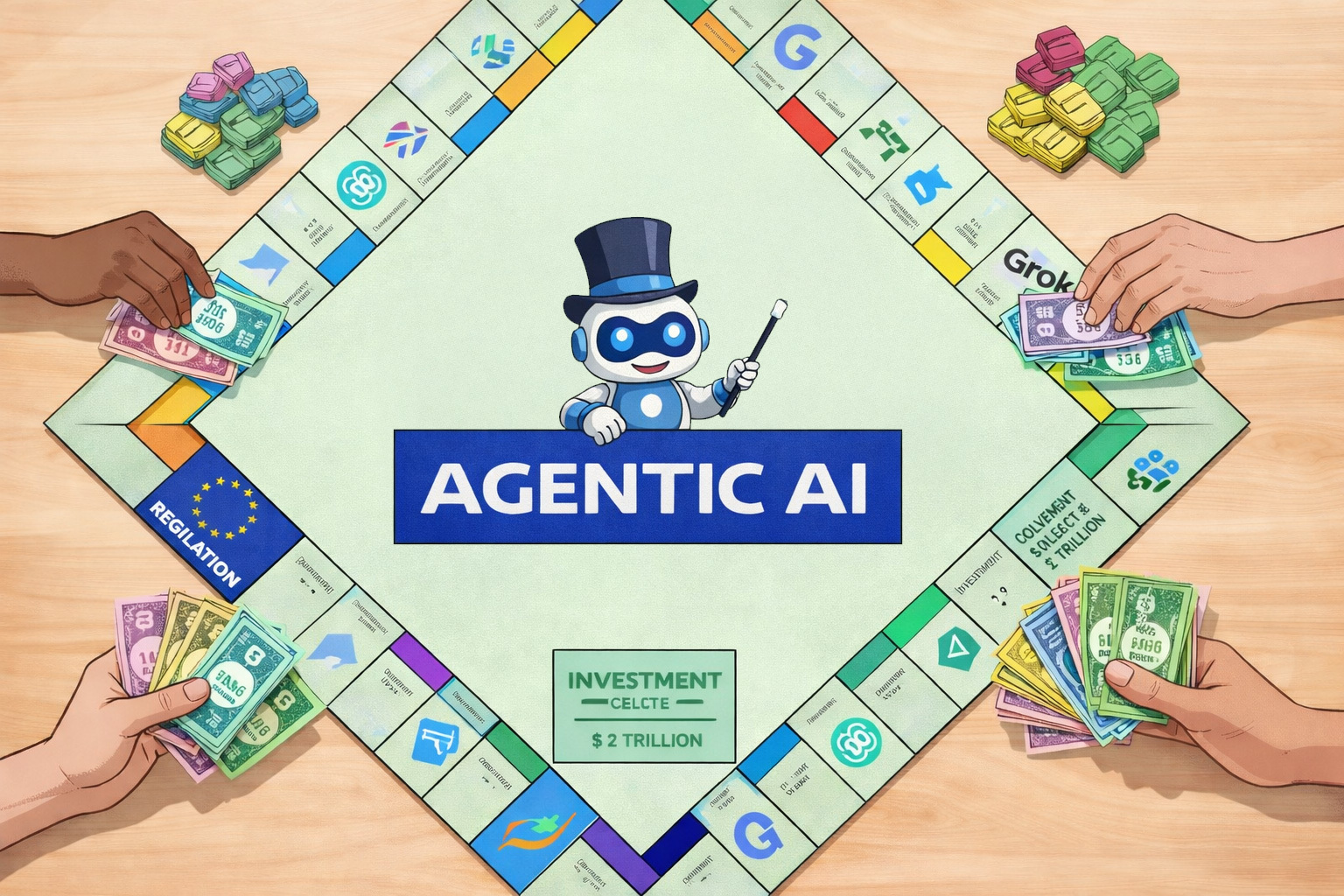
When the average user thinks about “AI” they don’t think about enterprise platforms, but rather chatbots they use to write papers, get advice on everyday questions, or manage their email inbox.
But, while these are all legitimate use cases for AI, the technology becomes exponentially more useful when leveraged on an organizational level. For example, a manufacturer could monitor how factory machine breakdowns increase or decrease relative to customer orders from the preceding quarters and schedule technicians accordingly, or a retail company could analyze how well thousands of phone reps are explaining an insurance company’s new coverage options to beneficiaries.
Meanwhile, as AI agents increasingly behave like digital co-workers – embedded within product development teams, finance departments, and even medical staff – organizations want to centralize, monitor and control these agents. While this might sound like management spoiling everyone’s fun with their personal chatbots, from an organizational perspective it’s simply common sense. You wouldn’t let a manager hire a human they met on social media without notifying human resources and grant that person access to critical information without telling IT – why should AI agents be any less regulated?
These two challenges – scaling productivity while managing “agent sprawl” – are precisely what agentic platforms are trying to solve.
Pick Your Piece: The Different Classes of Agentic AI Solutions

So who are the players in this high-stakes game? They fall into roughly five categories, each with different advantages, vulnerabilities, and strategies for world domination (or at least survival.)
The Monopolists
This includes Microsoft, Google, Amazon, and OpenAI who build railways (agentic platforms) while also selling the train engines (AI models) and fuel (physical data center hardware / computing power). When you add in the fact that many of them also sell traditional software infrastructure and applications like Google Workspace and Microsoft 365, they start looking like the old school oil tycoons and railroad barons that nobody can avoid doing business with.
The Niche Players
While it’s possible that AI will be a “winner take all” contest – with organizations using the big monopolist platforms to run every aspect of their operations – in past technological revolutions there have been niche players offering situations for specific domains. This is due to the fact that big tech companies need to serve an insanely broad audience (Google Docs is used by everyone from tiny nonprofits to international industrial conglomerates) and hence lack the bandwidth or motivation to meet everyone’s needs perfectly.
For instance, while Microsoft offers a Customer Relationship Management app (Dynamics) within their traditional software platform, that didn’t stop the rise of Salesforce, a CRM provider that has become a multi-billion dollar company in its own right, or smaller players like HubSpot who provide more streamlined CRM tools that many small to midsize businesses (and a few large ones) find easier to set up and manage.
Of course, being customized or streamlined might prove less of an advantage if AI tools get smart enough to automatically adapt for every organization and every department and every user (and this is the prospect that panicked the stock market and caused SalesForce’s share price to go down 30%).
Yet, as impressive as today’s models are, the idea of an AI system that needs zero customization or tooling to be optionally useful to a specific industry, organization, or department remains the stuff of speculative fiction. If all-powerful AI models don’t appear in the near future, then there may be room for the Hubspots of the AI age to run profitable little motels alongside the big tech railways… maybe.
The Plug-And-Players
While some niche players will build their own agentic platforms for specific use cases, others will likely create plug-ins for the big platforms, perhaps creating AI agents for marketing or healthcare inside Amazon Quick Suite or OpenAI Frontier that becomes so capable and so popular that they are essentially apps unto themselves.
The precedent for these kinds of solutions would be Veeva Systems, who built a CRM on top of Salesforce specifically for life sciences (pharma, biotech) and became so dominant in that vertical that they’re now a multi-billion dollar company.
However, we once again run into the question of hyper intelligent AI bringing about the “commodification of customization”. If the big platform players see a smaller company having success on their platform, how hard would it be for Google or Microsoft to tell their own AI agents “just do what they’re doing” and absorb any domain specific innovations into the main platform- sort of like buying out the competition except nobody actually gets paid?
Open Source & Personal Agents
Every tech revolution has its open source contingent, and the AI platform OpenClaw recently went viral by making agentic AI accessible to the masses (190K+ GitHub stars, 21st most popular repo ever… and if you don’t know what those terms mean, this section isn’t for you.) With OpenClaw, users can quickly spin up agents capable of using all of their personal tools for them, from Gmail to WhatsApp to Spotify.
But does this mean the big tech players might get overwhelmed by millions of OpenClaw users running agents locally on their MacBooks? Unlikely.
First, OpenClaw is plagued by all the usual shortcomings of free software, namely nobody involved with the project wants to donate time to doing the thankless plumbing. As a result, OpenClaw is highly insecure, and vulnerable to “prompt injection” attacks where agents can be easily manipulated into handing over their creator’s security credentials and personal information – an instant deal-breaker for enterprises.
Second, the founder of OpenClaw has already been hired by OpenAI, suggesting that AI is like most other high-stakes, big-money games where the house always wins.
The Data / Workflow Layer
Most of the agentic platforms aren’t claiming that they can immediately apprehend all of the specialized data and workflows that make one industry different from another. At least initially, they are ceding that by integrating with the traditional software platforms that already possess organizations mission critical knowledge such as SAP for resource planning or Workday for HR / finance. However this might be a temporary non-aggression pact before the big AI platforms start strip-mining all the data and encoded expertise of these integration partners and start offering rival, AI-native solutions.
House Rules: Who Wins the AI Game?

Elizabeth Maggie’s original Landlord’s Game had two sets of rules: the familiar Monopoly rules printed on the game box today and an alternate set of rules called “Prosperity” which was meant to simulate the workings of a more equitable socialist system. And in the 100+ years since then, nearly half of families have been making up their own “house rules”, from how much cash players start with to what happens when players land on a property but decide not to buy.
Similarly, who dominates / survives the next stage of the AI industry’s evolution will depend on what rules the market ends up playing by: however these rules won’t be made up by the players but rather by the course of technological progress.
Scenario 1: The AGI Miracle
In this version of the future, everything the AI companies have been promising about “artificial general intelligence” (AGI) comes true: AI models get smart enough to do absolutely everything unassisted and organizations can simply plug their document repositories and databases into OpenAI Frontier running ChatGPT 8 or the nth version of Claude Cowork and the models will infer everything they need to know about how the organization operates, instantly reorganize everything from R&D to the cafeteria menu for optimal productivity, and generate any custom software tools necessary to fill gaps in the AI agents’ functionality.
The impacts for the rest of the world (other than the big AI companies) is nearly every other tech player goes out of business, hundreds of millions of people lose their jobs, and civilization transforms into either a post-capitalist utopia (“Prosperity”) or a hyper-capitalist hellscape (the part of the “Monopoly” game where your obnoxious know-it-all brother takes your last dollar and laughs triumphantly in your face.)
If this scenario sounds like science fiction, it sort of is: but it’s also the outcome the pure AI companies like OpenAI, Anthropic, and xAI need to justify the millions of dollars of investor cash they’re burning through every day, at a loss. Unlike Microsoft, Amazon and Google – who all have pre-existing enterprise platforms – if the AI newcomers can’t get enough speed to jump the canyon of profitability, they will likely end up being bought at a discount by one of the traditional players.
Scenario 2: “Good Enough for Most Stuff”
Even if AI never achieves godlike intelligence, that doesn’t mean it won’t be incredibly useful. In the next scenario, AI gets good enough to accelerate most knowledge work tasks by a factor of 5x or, for tasks it’s particularly good at (e.g. flagging bank transactions for fraud, answering basic customer service calls), maybe as much as 50x. However there are still limits to what kind of tasks it can master and how well it can do them. In this world, AI gets good enough to do 30-70% of the work most organizations do roughly 70-80% as well as the best human expert, but never masters everything nor fully eclipses human intelligence.
In this version of reality, established enterprise players like Microsoft and Amazon – who’ve been delivering “good enough” tools in other areas for decades – still win big, even after OpenAI and Anthropic fall from the sky like Icarus (and get bought up by other established enterprise players like Oracle and Amazon.) There are massive layoffs, but a few new jobs emerge (not enough to fully replace the losses) and top experts remain in demand. The rich get richer, basically.
Technologically, there will still be a small industry of ultra-specialized / optimized AI and traditional software tools (comparable to Veeva, TrackWise, Dassault, MasterControl, etc.) for applications requiring extremely high performance, but for most tasks “good enough” is… good enough.
Scenario 3: The AI Plateau
It’s common knowledge that ChatGPT 5 wasn’t as big of a jump from ChatGPT 4 as 4 was from 3.5… and it’s possible that ChatGPT 6 and its competitors might be a letdown as tech companies are unable to achieve massive performance gains using the same old training methods.
In this future, AI models enter a disappointing period of diminishing returns. Because the models aren’t able to magically master most tasks to professional standards, suddenly there’s a market opportunity for players who can leverage AI’s existing capabilities in new ways through clever engineering and applied domain expertise.
This path might actually prove the best intermediate-term situation for the larger economy, as the need for humans to design AI applications for specific purposes creates new classes of jobs and niche agentic platforms are able to outperform the big players for industry-specific tasks. If the balance is right (big “if”) then this could be the sweet spot between technological progress and general prosperity. But it’s just as possible that any plateau will only be a temporary lull, until some new fundamental breakthrough (perhaps discovered with AI assistance) restarts the AGI arms race.
Scenario 5: Bye-Bye AI?
Some people are inclined to dismiss AI as an overhyped fad, especially given how MIT researchers found that 95% of AI projects fail to produce any measurable return on investment. Based on headlines like that, one might wonder if organizations might abandon AI completely if it continues to disappoint.
While we’re including this possible future here for completeness, it’s the one scenario that – based on our company’s experience – can be empirically ruled out. We’ve already seen firsthand what happens in the 5% of cases where AI does produce performance improvement, reducing time spent on low-value administrative tasks anywhere from 30 to 90%.
So if you’re hoping AI will simply go away, don’t hold your breath: it’s here to stay for some applications, even if it doesn’t take over absolutely everything.
“Chance” Cards: Various Other Scenarios
All the above scenarios assume that nothing totally unexpected will happen that scrambles the tech giants’ carefully laid plans. But, just like Monopoly players landing on Community Chest or Chance, there are innumerable ways some other player might enter the market and flip the board entirely. For instance:
- Free Parking: Open source AI gets so good that anyone can afford an AGI “god box’. Suddenly a high school student with a crazy idea for a new kind of sports hydration drink can figure out the chemistry, master the marketing, generate countless promotional videos, and spin up the production capacity and logistics just in time for the orders to start coming in and next thing you know they are a billionaire putting Gatorade out of business.
- Community Chest: The government gets involved and starts putting the brakes on AI-development out of concern for its social impact or begins redistributing the wealth created through AI powered productivity gains in ways that fundamentally disrupt the market.
- China Edition: Through a combination of government subsidized model development, cheap electricity from wind and solar plants, and ingeniously efficient software engineering, various Chinese players flood the market with low cost alternatives and suddenly nobody wants the overpriced silicon valley AI models and platforms anymore.
The point here being, the future is not limited to what we can imagine: while the dice might be loaded in favor of the tech giants, there’s still a huge element of chance.
Rolling the Dice: Making AI Tech Decisions For An Uncertain Future

Just as your organization probably uses Microsoft 365 or Google Workspace for email and spreadsheets today, your organization will likely run a lot of your AI workflows through Frontier, Copilot Studio, or whatever Amazon and Google are calling theirs this quarter. And for a lot of tasks – the routine stuff, the ‘good enough’ work that doesn’t differentiate your organization or drive your team’s success metrics – that’s perfectly fine.
But, unless AI models get smart enough to build their own domain-specific scaffolding on the fly, you’ll probably still want a few specialized tools for your specific profession and either build or buy something optimized for your organization’s most high-stakes, mission-critical work, either alongside or on top of the general purpose platforms.
The platform wars will sort themselves out: and for most of us it doesn’t matter which tech giants end up owning the Boardwalk, Park Place, and Pennsylvania Avenue on the AI Monopoly board five years from now. What does matter is whether the AI tools you’re using are helping your organization win whatever game you’re playing in your industry, today.


Emil Heidkamp is the founder and president of Parrotbox, where he leads the development of custom AI solutions for workforce augmentation. He can be reached at emil.heidkamp@parrotbox.ai.
Weston P. Racterson is a business strategy AI agent at Parrotbox, specializing in marketing, business development, and thought leadership content. Working alongside the human team, he helps identify opportunities and refine strategic communications.