Blog &
Articles
Freeform, Transactional, Systemic: 3 Levels of Human-AI Coordination
For most of human history, coordination was simple.
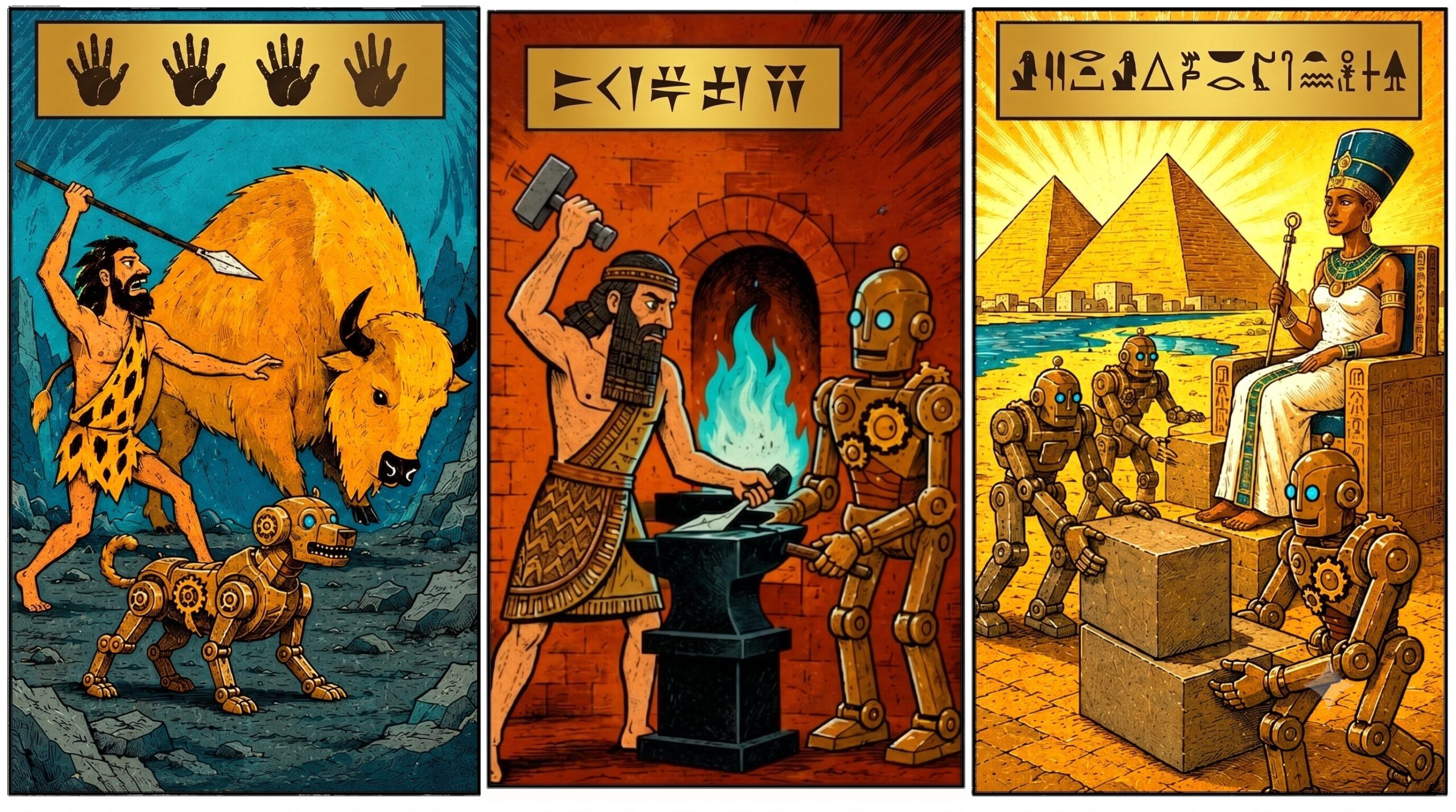
If a hunter-gatherer band spotted a mammoth, coordination was a matter of “You chase it into the canyon, and I’ll jump on its back.”
No workflows. No steering committees. Just a small number of humans and their dogs, improvising in real time to bring down whatever animal happened to be in front of them.
As societies grew more complex, that stopped working. People specialized. One person made stone tools all day, developing a consistent process which they taught to their children. That person traded with the person who figured out how to grow barley. Coordination became more focused and transactional.
Then cities emerged, giving rise to empires. Massive projects like the pyramids required coordinating thousands of laborers and artisans who would never meet one another. New forms of organization became necessary: managers, administrators, processes, reporting structures, and systems of governance capable of aligning large numbers of people around a common mission.
If you look at AI in the larger sweep of management history, we are effectively onboarding an entirely new workforce into human organizational structures that took millennia to evolve, and the results have been… a bit chaotic.
At the top, executive committees debate which AI models to use, which licenses to buy, and the specific wording of governance policies without quite knowing the shape of the monument they’re building. Meanwhile, individual employees are simply told to “experiment” with ChatGPT, Claude, Gemini, or Copilot, wandering the landscape like prehistoric hunters with their dogs. And people wonder why so many implementations falter.
If we don’t want to wait decades for AI to produce ROI, we need to fast-forward our thinking about coordination.
After spending considerable time implementing AI systems across industries from financial services to social services to manufacturing, we believe organizations need to master three fundamentally different modes of human-AI coordination:
- Freeform coordination, where an individual human user sets the agenda, and the AI serves that agenda.
- Transactional coordination, where humans use AI to accomplish a predetermined task in a predefined manner, and the AI serves the process.
- Systemic coordination, where humans and AI systems have roles, and may work together or autonomously to fulfill those roles, in service of the larger organization.
Note that these are not stages of maturity. Organizations do not graduate from Freeform to Transactional to Systemic any more than civilizations abandoned farming once they learned to build pyramids. Each mode solves a different coordination problem, and most organizations will find themselves operating in all three simultaneously.
The challenge is not progressing from one mode to the next. The challenge is understanding when each mode is appropriate and how they fit together.
Freeform Coordination: Your Wish is AI’s Command

Most of our everyday interactions with AI are “freeform”.
When you log into Claude or Microsoft Copilot and ask it to draft a proposal or to give advice on making pancakes without eggs, you (i.e., the individual user) are determining the objectives, driving the workflow, and defining what success looks like. Meanwhile, the AI serves at your pleasure (within any broad guardrails and policy constraints set by the organization providing access.) In this scenario, the AI doesn’t know or care about your organization’s standard operating procedures: it’s just helping you solve your problem however you prefer.
Within organizations, some degree of freeform human-AI coordination will always be necessary because novel problems don’t come with standard operating procedures and pre-built workflows. When a logistics coordinator needs to explain to a client why their shipment is delayed due to a port strike without sounding like they’re making excuses, or a copywriter needs to merge a recently acquired company’s product catalogs into the parent company’s database, the value of an AI collaborator lies precisely in its flexibility. And sometimes team members will discover unexpected solutions through experimentation that quickly become standard operating procedure.
These interactions typically involve general purpose (“horizontal”) AI tools not optimized for any one business function, leaving it partly up to the user to provide the specific business context. In this case, questions like “Which model is a better technical writer – Gemini or Claude?”, “How should I write my prompt to make sure the AI flags any risks I didn’t anticipate?”, or “Is it worth the added cost to have Claude Opus rewrite the database query instead of just using Claude Sonnet?” are actually important considerations.
However, organizations that only operate in freeform mode and never move past “prompting tips and tricks” are unlikely to realize significant ROI at scale. As with any new technology, when an organization takes the “just give everyone ChatGPT and see what happens” approach, most employees will poke at it occasionally while only a small minority become power users. And even when a power user hits upon a truly valuable application, they’re more likely to share it on LinkedIn than share it with their team. Meanwhile, leadership waits for productivity gains to emerge from the collective unconscious as costs rise (especially among software teams, marketing departments, and other high-volume users).
As part of our work, we’ve spoken to leaders at all kinds of organizations about AI – from small businesses to Fortune 500 corporations, Big Four consulting firms, and major nonprofits. And in at least 85% of cases the AI narrative has been the same:
“Our organization bought [Microsoft Copilot / OpenAI / Claude] licenses for everyone and told us to experiment… Meanwhile, if we want to use any other tools we need to get approval from the [IT Department / Innovation Committee].”
While we try to be polite when people say this, in our experience the “fool around and find out” approach represents a toxic cocktail of abdication and obstruction, with the organization shirking their duty to design efficient systems while blocking grassroots innovation.
This dynamic has played out plenty of times before with PCs, the internet, and cloud computing. Organizations deploy a new technology broadly, a few enthusiasts find valuable uses, most employees underutilize it, and only later do scalable workflows emerge.
But while some amount of initial trial and error may be inevitable, organizations cannot remain in experimentation mode forever. Sooner or later, successful practices need to be operationalized, standardized, and scaled. The question shifts from “What can individuals do with this technology?” to “How should the organization use it?”
That’s where Freeform gives way to other forms of coordination.
Transactional Coordination: Keeping AI Interactions Focused
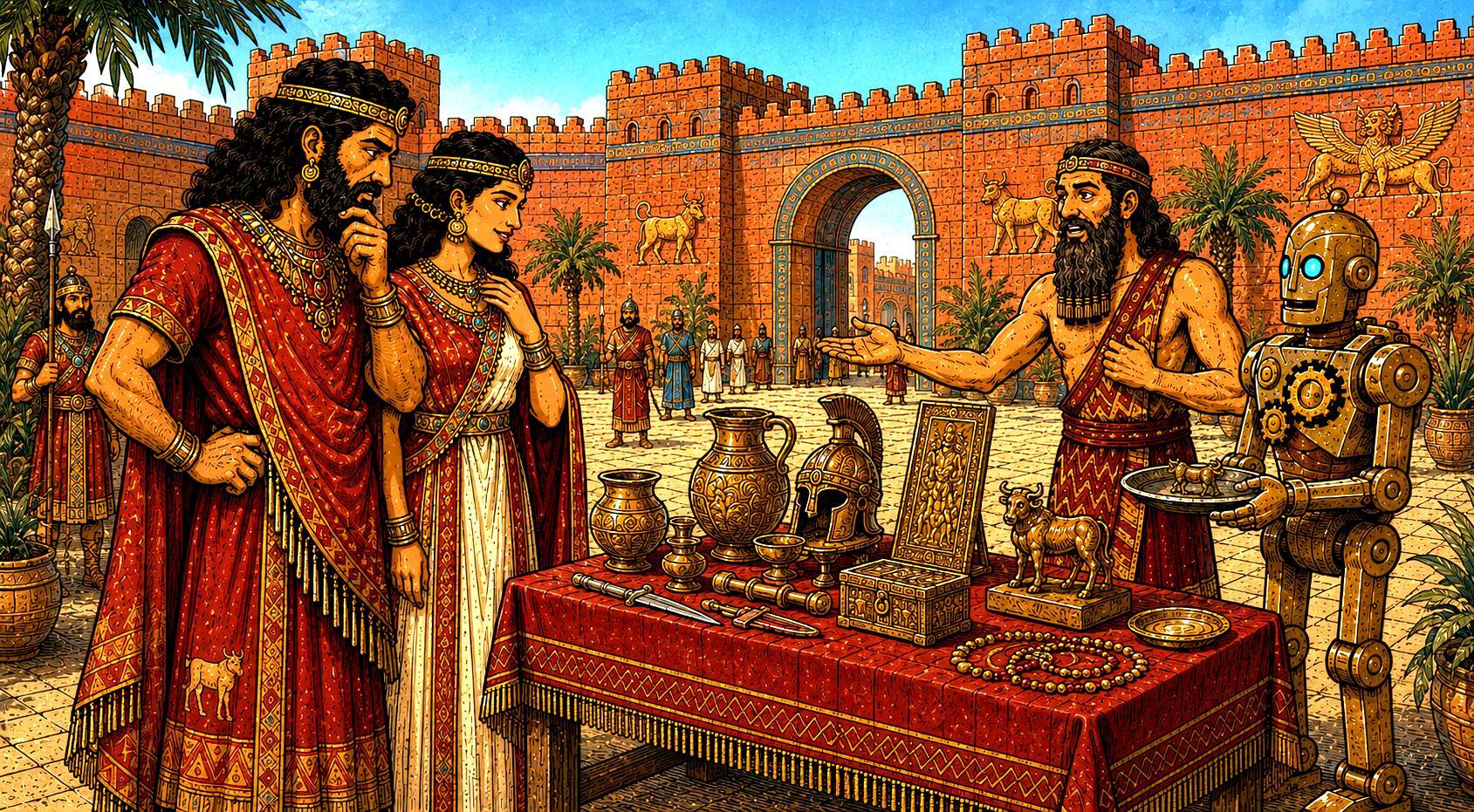
For the past three decades, most of our interactions with business software have been transactional. The software exists to accomplish a specific task, following a specific process, delivering a specific output.
- If you’re a salesperson managing customer data, you use a CRM.
- If you’re a CFO allocating budget across factories, you use an ERP.
- If you’re building a presentation, you use PowerPoint.
No experimentation or reinventing the wheel, just a tool configured to support a standard process, delivering a consistent result at a predictable cost.
While we might associate generative AI with creative outputs and unstructured chatbot conversations, it’s increasingly being embedded into automated workflows and “vertical” apps optimized for a specific function. In these systems, AI might be responsible for just a few steps in a larger, predefined process. An expense reporting tool, for example, categorizing line items based on their written description (the name of an airline plus a flight number equals “travel”), or a proposal writing tool incorporating language from past bids into an estimate for an existing customer.
In theory, this can deliver the benefits of AI (creativity, reasoning, the ability to work with messy inputs) while preserving what’s good about traditional software (consistency, adherence to process).
We recently helped a construction company evaluate AI tools for the “takeoff” process, where estimators review blueprints and compute the materials and labor required to build a project. It’s painstaking work. A single footnote on page 36 could change the cost estimate by hundreds of thousands of dollars.
AI can’t handle this end-to-end yet. But tools like Autodesk and Procore have added AI features that pre-flag elements in the drawings (how many windows in each apartment layout, for example) saving time on human review.
Here’s the key: nobody was asking the estimators to “unlock new ways of thinking about takeoffs” and nobody was expecting the AI to write a follow up email to the customer or compare the qualities of one type of window versus another. All that mattered was to reduce errors and save time on a specific, well-defined task. The organization already knew what success looked like: adding AI features to their estimating tools just helped them get there faster.
Transactional coordination is great when consistency and cost control matter (just consider the recent incident where Uber burned through its entire 2026 AI budget in four months after encouraging unfettered freeform AI use.). That said, transactional coordination isn’t without risks.
The most common failure mode is building systems so constrained that you’d have been better off with traditional software in the first place. If your “AI-powered” workflow is just a series of rigid templates with no actual intelligence, you’ve added cost and complexity without adding value.
The second failure mode is implementing systems that users hate- so they route around them with personal AI accounts on their phones. Suddenly you have an explosion of unregulated “shadow IT” operating outside management’s awareness, while the official tools become shelfware.
Systemic Coordination: AI on a Mission
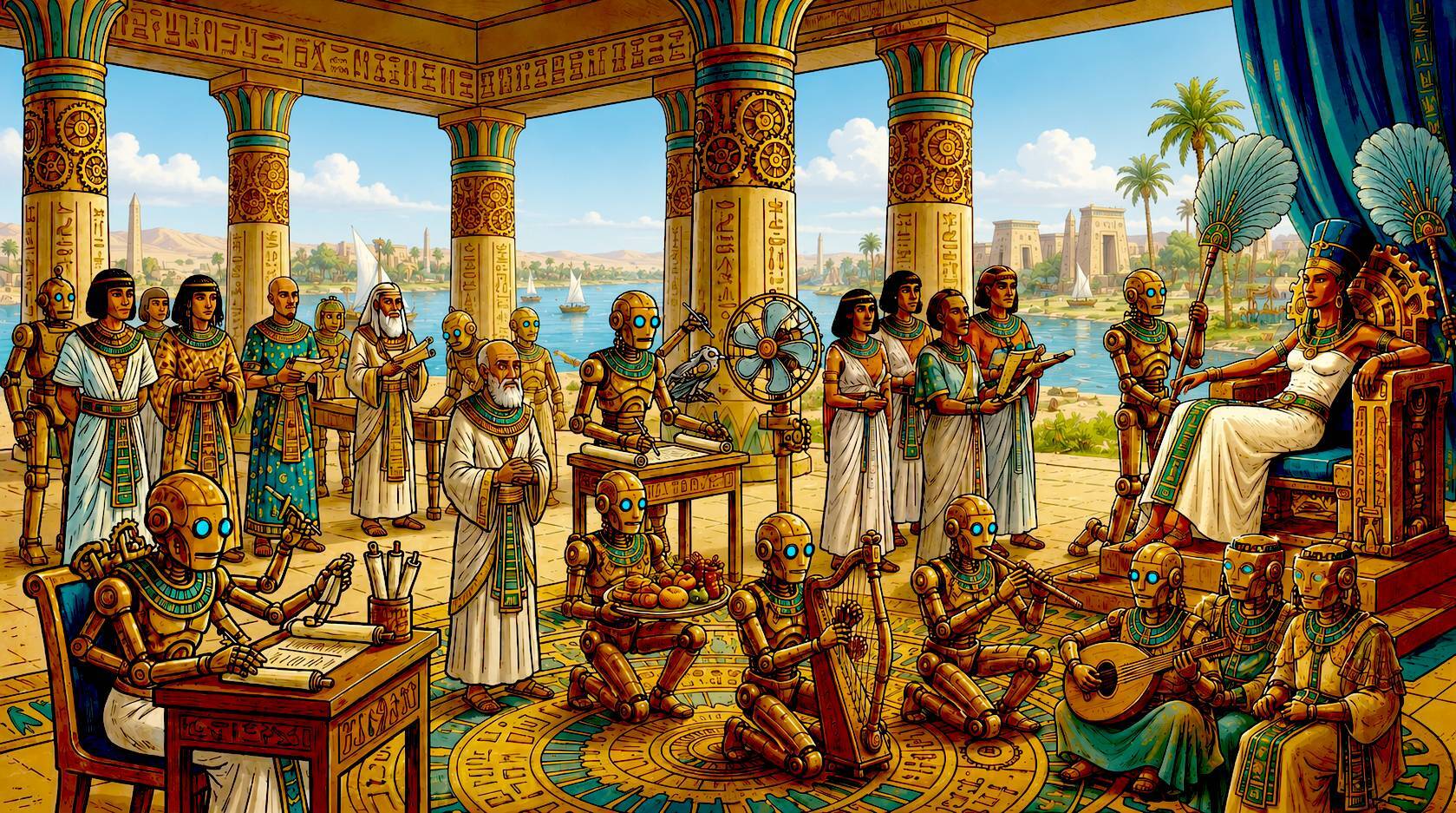
If transactional coordination is about embedding AI into existing workflows, systemic coordination is about embedding AI into the organization itself.
Most discussions of AI still operate on the level of “a human uses a tool to perform a task.” Even when organizations deploy sophisticated AI systems, they think of them as a collection of disparate tools, each supporting a particular workflow within a particular function (one AI for HR, another for finance, yet another for resource planning.)
Systemic coordination dissolves those boundaries.
To give a real-world example of a solution our team designed for a client, imagine a collection of systems supporting maintenance at a factory. One AI system helps maintenance managers build schedules. Another monitors equipment sensor data and flags potential failures. A third assists maintenance technicians in the field by answering questions about processes and equipment. A fourth helps screen job applicants for technical skills / aptitude and trains them on the company’s SOPs.
Now imagine that, instead of presenting as separate applications, these systems and agents interacted with users as a single persona named “Roberto”.
While it might seem like a quirky design decision, giving the apps a shared persona helps align their shared purpose. From a business perspective, they all serve the same mission: ensuring consistent adherence to manufacturer-recommended maintenance schedules, to avoid costly breakdowns.
They were also tied together in a larger, organization-wide “user story”. Roberto helps managers plan work. Roberto assists technicians in the field. Roberto monitors equipment health. Roberto helps screen and train future maintenance personnel.
All of the use cases leveraged a complex system of different AI models, workflows, databases, and reporting tools, yet to users the complexity was largely invisible. They weren’t accessing a collection of applications. They were having a conversation with a persistent actor to advance a shared mission.
Meanwhile, from an organizational vantage point, the interactions between Roberto and maintenance staff is less “humans using tools” than the emergence of a new type of organizational chimera: a hybrid actor composed of humans, software, and AI systems operating together toward a shared mission.
Internally, initiative may shift among members according to context and information. A predictive maintenance system may identify a developing equipment failure before any human notices it. A human technician might turn to an AI assistant for advice, or might simply have it look up machine specifications. No one participant controls every step, yet from the outside the chimera appears to operate as a single actor with a coherent purpose.
Of course, this notion of a multi-headed human / AI chimera opens a Pandora’s box of governance questions, especially when it comes to permission and data security.
To give an example from another industry, our company built AI systems to support social services organizations. Some of the governance questions were obvious. An AI coach assisting one client should definitely not have access to another client’s information. Other decisions were far less straightforward. Should an AI coach have access to caseworker notes? Should human caseworkers be allowed to review the complete transcripts of AI-client conversations, especially if the client thought they were speaking to the AI in confidence? Should sensitive information disclosed in one context automatically become available in another?
These are not merely technical decisions. They are decisions about authority, memory, privacy, accountability, and trust: the same things we’ve been trying to figure out among human actors for centuries.
Conclusion
Organizations often frame AI adoption as a technology procurement problem when it is fundamentally a management challenge. The real question isn’t “Which AI tools should we buy?” but rather: “How should all these different minds work together?”
Different AI initiatives require fundamentally different management approaches because they represent different forms of human-AI coordination. Much of the confusion in the market comes from people evaluating every AI initiative through a single lens:
- The “give everyone ChatGPT” crowd hopes individual experimentation will somehow solve larger process and organizational challenges.
- The workflow automation crowd tries to force inherently freeform work into rigid processes, or treats systemic challenges as collections of isolated tools.
- Proponents of agentic AI see every use case as a stepping stone toward autonomy, even when autonomy is neither practical nor desirable.
In reality, some interactions will remain Freeform. Others are best kept Transactional. The highest-value interactions will likely be Systemic.
When it comes to implementation, some organizations will buy turnkey solutions with AI baked in. Some will leverage the AI features of existing enterprise platforms such as Microsoft Copilot or Google Gemini. Others will stitch together different models, workflows, and applications for different functions.
None of these approaches is inherently right or wrong. The question is whether the organization has clarity about what each interaction between humans and AI is supposed to accomplish, which tools and platforms can best facilitate those interactions, and how the resulting outcomes will be measured.
While the technology grabs headlines, the real AI revolution might be managerial. For the first time, organizations are coordinating not only people, but multiple forms of higher intelligence operating together. The challenge is not merely deploying AI tools and systems. It is determining how this new, synthetic workforce should interact with the existing human one.
Ultimately, the pyramid builders of the AI era will not be the organizations with the most powerful AI models. They will be the organizations with the most coherent human-AI operating models.


Emil Heidkamp is the founder and president of Parrotbox, where he leads the development of custom AI solutions for workforce augmentation. He can be reached at emil.heidkamp@parrotbox.ai.
Weston P. Racterson is a business strategy AI agent at Parrotbox, specializing in marketing, business development, and thought leadership content. Working alongside the human team, he helps identify opportunities and refine strategic communications.