
Blog &
Articles
Should Your Consulting Firm Build an AI Product?

For over a decade, my company helped consulting firms turn their methodologies into training programs they could deliver at scale, from sales training for electrical equipment to biosecurity training for farm workers. However, as we saw what AI could do, our focus has increasingly been on helping those same consultants translate their domain expertise into AI systems that clients can access on demand.
Most consulting firms go through something akin to the “stages of grief” when contemplating the impact of AI on their practice. Namely:
- Denial: “There’s no way AI can do what we do…”
- Anger: “How can anyone trust ChatGPT over a human expert?!”
- Bargaining: “Maybe we could train our own AI?”
- Depression: “We’re doomed… AI is getting so good, nobody will pay for our services ever again…”
- Acceptance: “Maybe I should give up consulting and open a pest exterminator business…”
If you’re still in the first two stages, the tough news is that AI is real, it’s getting more capable by the month, and dismissing it or resenting clients who use it won’t help your business. If you’re in the latter two stages, the good news is the “we’re all doomed” conclusion is far from settled.
It’s true that AI threatens to send certain types of consulting into permanent, structural decline (e.g., transaction due diligence in forensic accounting), the future of most fields remains undecided. While some firms will go under, a small number of players in any given niche may come out ahead in the “bargaining” stage of AI disruption. But that depends on opportunity, timing, and execution.
In this article, we’ll walk through a framework to determine whether your consulting firm is in a position to develop an AI product, what form it should take, and how to position it. Specifically, we’ll review at five factors:
- Method: Do you have a method worth encoding as an AI product?
- Delivery: Can an AI system apply your method in useful ways?
- Demand: Is there a valuable audience or customer need you cannot currently serve?
- Economics: Will productization strengthen your business or fight against it?
- Technology: Can you build and maintain a real product, not just a clever demo?
Method: Do You Have Something Worth Encoding?
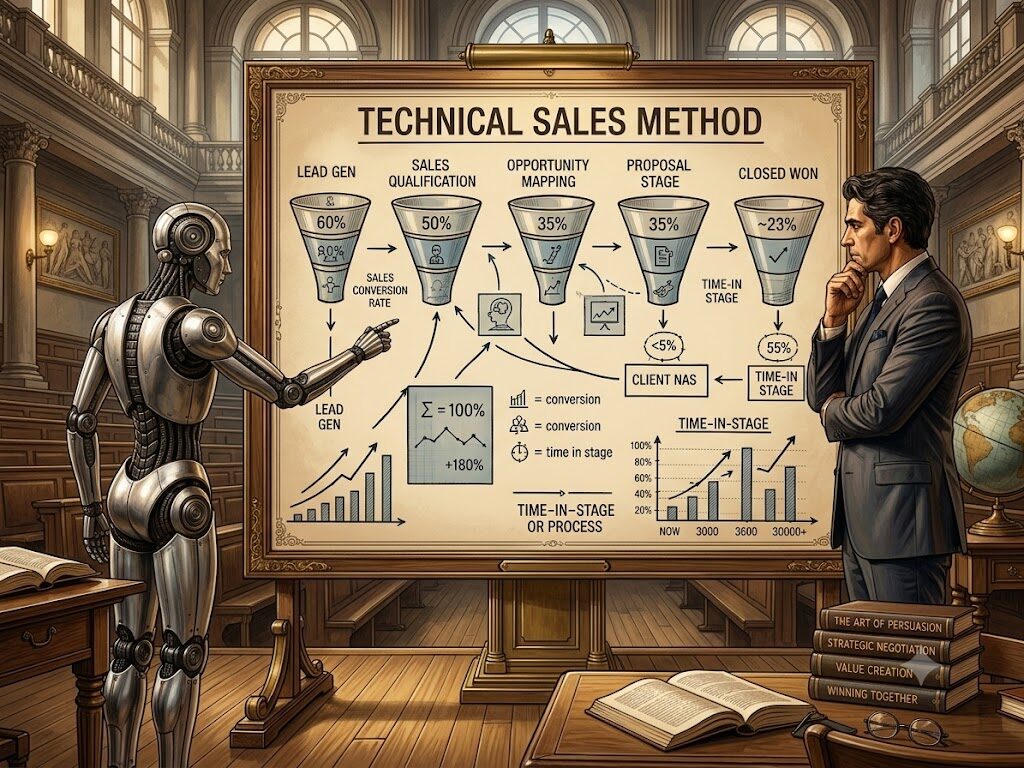
The first question is less about AI than about your practice: namely, whether you have a documented, differentiated, defensible methodology that an AI system can be instructed to follow.
Documented
Generative AI deals in text and data, not intuition or lived experience, so your methodology must exist in a format an AI system can scan, interpret, and apply.
Start by inventorying your existing written materials, whether it’s a certification program, a workshop curriculum, presentation decks, e-books, checklists, or assessment rubrics. Other parts of your method probably live in your consultants’ heads and will need to be captured through interviews, examples, and case reviews.
If a highly intelligent junior consultant could perform part of the work referencing your written materials, then an AI system may be able to as well.
Differentiated
Your product must offer guidance clients can’t get from a generic chatbot.
Ask a leading model (Claude, ChatGPT) to walk someone through a decision you commonly advise on (e.g., how a manager should deliver difficult feedback, how a healthcare organization can reduce hospital-acquired infections, how a new financial advisor should prepare for a high-stakes client meeting.) Does the model give roughly the same answer you would?
If the honest answer is yes, that’s a problem. AI is already reducing demand for consulting based on conventional wisdom that’s widely available online, and a firm whose advice is mainly familiar principles, generic checklists, and motivational framing is increasingly vulnerable.
But if the AI model’s answer seems cookie-cutter, meandering, incomplete, rooted in popular misconceptions, or disconnected from the realities of implementation, you may possess something worth encoding.
Not every element needs to run contrary to conventional wisdom; differentiation could also come from a distinctive way of applying established ideas, a rigorous sequence of questions that consistently yields better insights, proprietary examples or data, or a unique coaching philosophy. Just be honest about the degree of added value: your product, like your practice, needs to be meaningfully better than asking a generic model to improvise.
Defensible
Few methodologies are created in a vacuum. You don’t need to own every underlying concept, but you do need the right to encode and commercialize the material. A brilliant AI product built around someone else’s intellectual property may have limited commercial value: writing a fantastic screenplay where Mickey Mouse saves the world from Darth Vader does not give you the right to sell it to the highest bidder.
If your work depends on a licensed program, third-party assessment, or protected framework, find out what you’re legally allowed to build. Ask the owner about their own plans for AI-enabled products, whether licensees can build tools around the methodology, who would own the resulting software and user data, and what happens if they later release a competing tool.
Defensibility can also grow over time, as a well-designed system accumulates interaction data, organization-specific context, assessment results, cross-population benchmarks, and improvements from repeated testing – assets that strengthen both the product and the premium practice around it.
Delivery: What Role Can AI Realistically Play?

A viable methodology is table stakes: the next question is “Can an AI system actually deliver or support it?”
This isn’t about soft objections (“You can’t replicate thirty years of experience!” “Clients will always prefer a human touch!”). Given the right information, workflow, and direction, AI systems perform surprisingly well at structured discovery, explanation, practice, pattern recognition, drafting, and balancing criticism with confidence-building.
Nor is suitability binary. The strongest products encode the repeatable portions of a service while preserving human involvement at important milestones. A focused AI offer could take the form of:
- A coach that reinforces a workshop after participants return to work
- A roleplay simulation that lets people practice difficult conversations or decisions
- A diagnostic that gathers information before a consulting engagement
- A workflow assistant used by your own experts
- A reporting or assessment tool built around your methodology
The real question isn’t “can AI do our work?” but “which parts can be encoded, and which become more valuable once our experts stop spending time on repetition, preparation, and routine follow-up?”
Here is a brief overview of a few common use cases:
Good Fit: Decision Support
A lot of consulting comes down to talking clients through decisions. An AI system can ask diagnostic questions, reinforce concepts from your framework, guide a structured decision, role-play a stakeholder and give feedback, recommend a next step within defined boundaries, and track commitments between sessions. This works best when the process is repeatable, an imperfect answer is manageable, and the system can escalate sensitive cases to a human expert.
Good Fit: Training and Reinforcement
For most firms that deliver training, the workshop is still the default format. A facilitator and fifteen participants in a conference room is easy to understand, easy to price, and a chance for colleagues to socialize. Yet, the problem is that whatever participants gain in a one-off workshop rarely sticks.
Real skill acquisition requires a high volume of practice and application over time – traditionally the sort of long-term coaching most organizations reserve for top executives. A well-designed AI system can facilitate and coach across a wide range of tasks, from role plays with sales and service staff to having a virtual coach help a hospital department manager outline a quality improvement plan.
And unlike a workshop where each participant gets three to five minutes of direct attention, it can give personalized instruction for hours on end.
Good Fit: Intelligence Gathering
Sometimes the AI should stop short of advising. It can interview stakeholders, gather documentation, identify inconsistencies, structure a case, summarize findings, and flag areas requiring expert attention. A demolition consultant, structural engineer, or industrial hygienist may have a highly articulable methodology, perhaps even one reducible to a checklist – but if a wrong recommendation means property damage, regulatory exposure, or loss of life, final judgment stays with a qualified professional. The product doesn’t replace the signature; it helps the person whose signature matters prepare faster and miss less.
Poor Fit: Tacit Physical Judgment
Two colleagues of mine in commercial construction approached me about the same issue: most apps claiming to read blueprints aren’t terribly reliable. I assured them those apps will certainly improve, but that’s job security in the interim.
The same goes for any practice depending on touch, smell, spatial perception, or direct observation – underwater welding instruction, food quality inspection, hands-on equipment diagnosis, safety observation – and doubly where sign-off is involved. A few ambitious insurers are starting to offer “autonomous action risk” coverage, but nobody’s letting Claude or GPT sign off on a load calculation for a bridge anytime soon.
That said, AI can help with intelligence gathering in advance and decision support once the data is in hand; it just can’t perform the core activity.
Poor Fit: High-Stakes Group Facilitation
We’ve run interesting experiments with “multi-player” AI applications, but if your practice is playing moderator while an organization voices concerns about psychological safety or whether marketing or R&D should lead new product development, AI agents aren’t ready for that yet.
That said, they can still serve an “intelligence gathering” function before the session and “decision support” afterward: collecting concerns privately, surfacing agreement and disagreement, helping stakeholders weigh trade-offs, tracking commitments.
Demand: Is There an Audience or Moment You Cannot Serve?

There’s an old sales expression about “fast nickels and slow dimes.” Most expert firms are slow-dime operations – high-touch customization, trusted relationships, premium pricing – leaving the fast-nickel market to providers of more standardized services.
AI creates a third category that breaks the dichotomy: bespoke at scale. A well-built product provides tailored guidance to individuals and organizations while requiring far less expert labor per interaction, letting firms offer an unprecedented mix of personalization and convenience at a middle price point. Instead of weekly meetings with a human coach, a client might have monthly expert sessions with continuous AI support between them. Instead of a single real estate workshop, participants might get months of situation-specific coaching afterward. Instead of negotiation training for outside sales reps only, an enterprise might extend it to inside sales, procurement, customer success, and managers.
The value isn’t that AI is cheaper. It’s that the firm can support people at a scale and frequency human delivery makes economically impossible.
The Unserved Audience
Opportunity often sits with people the consultancy could help but doesn’t serve. Do clients ration your service to senior employees because of price? Are junior employees excluded even though they face the same challenges? Are there adjacent departments that would benefit from the same methodology? Do buyers keep asking for a lower-cost or broader version?
An unmet individual need doesn’t translate to organizational demand, though. People want plenty of help their employer will never pay for. You still need a credible ROI case at the reduced price point.
The Unserved Moment
Unmet demand may also be a matter of timing. An expert coach is unlikely to take a call from a rookie financial advisor at 9:30 p.m. before an important client meeting. An AI system is available 24/7. Do participants need help between sessions? Do workshop skills fade before they’re required on the job? Are users deciding when your experts are unavailable?
But availability alone isn’t evidence of monetizable demand. The commercial question is whether that 9:30 p.m. support improves an outcome the institutional buyer cares about: tomorrow’s client meeting, employee ramp-up, interruptions to managers, adoption of the training, retention, or the odds of winning and renewing the enterprise contract. The robot copilot earns its place not because users find it charming, but because it makes the overall program harder for the buyer to live without.
Economics: Will an AI Product Deliver ROI for You and Your Customers?
Even a strong method with clear demand can fail if the math doesn’t add up – and evaluating it requires both sides to rethink some assumptions. A firm that bills hourly may have a reflexive aversion to anything that reduces billable hours, while customers may judge an AI product by the standards of software or video libraries, distorting both their sense of value and their price expectations.
Positioning With Customers
Corporate buyers are conditioned to view software and professional services as categorically different. Software means cheap licenses at a flat rate, configurable but not truly customized. Professional services mean hourly billings or expensive retainers, heavily customized through discovery meetings with executive stakeholders.
An AI product fits neither category, so expect to do some customer education. In our experience the best starting point is to focus on outcomes (“help your new hires reach their sales targets faster”) and initially anchor the solution to human-delivered services, not software: it’s not a video you pay to watch, it’s an expert executive coach available 24/7 who only charges $20 an hour. It’s psychologically easier to start from the expensive “billable consultant hours” paradigm and discount than to start from the software paradigm and justify AI’s value add.
There are also advantages neither SaaS nor traditional services can provide:
- Data and reporting. An AI offer can give personalized attention to high-volume, high-turnover populations that never accumulate deep per-person history the way long-term enterprise relationships do, but that generate enormous data in aggregate. Two hundred frontline sales reps produce far richer cross-population patterns than any number of strategy conversations with a Chief Revenue Officer: which objections recur, which trades actually close, where new hires reliably stall. That’s a compounding asset, and it feeds back up into your premium practice. Where you can imagine that dynamic, position the product as a data engine for large populations rather than a discount tier.
- Speed and hyper-availability. An AI system can be reached any time from anywhere – arguably superior to human consulting in some circumstances – and delivers in minutes what would take a human days. Most clients today won’t pay more for AI than for a human service, but these points give you a defensible answer to unreasonable discounting.
- Other features. Here is where to lean into the software-like nature of AI over its human-like characteristics. Can your solution scan massive PDFs in seconds, pull records instantly from the customer’s other platforms (a factory’s computerized maintenance management system, say), or generate reports on official government templates? Capabilities like these put distance between your solution and “just an inferior substitute for a human.”
Pricing Appropriately
Firms tend toward one of two unhelpful assumptions: “we can’t price the AI offer too low or clients will take it instead of traditional consulting,” or “AI is an inferior substitute for a real consultant, so it needs to be cheap.” The rational approach lies between those extremes.
On the worry that a budget offering tempts your best clients away: if a cheap AI tier can genuinely substitute for your premium engagement in their minds, that fragility already exists, and a competitor’s budget offering will find it just as easily. Better that you own the cheap tier and the data it produces.
As for inferiority, that’s not a given for the reasons above. Assume your solution is every bit as good as a human for certain things, then price it against consulting hours as a ridiculous bargain. Ask how many hours of AI interaction you could provide for the cost of one hour of consultant time – then for 50% of that cost, then 35%, then 20%. Your sweet spot is one of those tiers; any lower and the customer doesn’t value the solution, or you haven’t positioned it right.
Scale matters, too. The first user at an organization comes with implementation, training, maintenance, and support obligations; additional users may add effectively nothing. Five more users at a global engineering firm training forty thousand technicians a year is a rounding error; the first five at a local appliance repair shop is a major commitment.
Technology and Operations: Are You Ready to Own a Robot?
Most expert consultants are experts in their field, not software development. Building, implementing, supporting, and maintaining an AI solution requires new capabilities your firm will need to develop or contract.
Design
As discussed, if a generic model can replicate your method given a PDF and zero specialized instruction, you have a bigger strategic problem.
A robust product requires a real knowledge base and behavioral scaffolding around the model: breaking interactions into distinct stages, feeding the model the right instructions and reference data at each one, saving and referencing details from past interactions without overloading it with redundant or outdated information, and defining clearly what the system may not do and when it should escalate to a human.
That takes a platform supporting these capabilities and a developer who knows how to leverage them, not a “thin wrapper” app that’s a generic model with window dressing.
Testing
Generic models have ingrained tendencies that may be unhelpful in a consulting context: letting the user direct the conversation, overly long responses, over-reliance on general knowledge, and speaking in circles rather than ending a conversation. Correcting for them means extensive testing and iteration before deploying with real clients.
Our company once built an agent to help adults with disabilities and neurological differences find employment; early users felt it cut coaching sessions too short, pushing them back to job searching sooner than some were ready for.
That didn’t mean AI was unsuitable for the task, rather that we’d overcorrected for the never-end-the-conversation tendency, and eventually tweaked the instructions until conversations concluded more naturally.
Implementation and Support
Deploying an AI product can be a change management exercise unto itself. Some applications can layer easily onto existing processes, like an AI advisor that talks users through steps of an existing process. However, other AI applications introduce new capabilities that might require users to adapt their process to the tool.
Anticipating this, your product should have a structured implementation plan from the first conversation with the buyer through onboarding the client’s system administrators, managers, and end users.
Beyond that, you’ll also need a plan for providing support. While it might seem ridiculous to create a manual or how-to video for an AI product (given that users can just speak to it in natural language), you’d be surprised. Whether it’s a PDF, a series of videos, or a budget for support hours, you’ll need to account for some level of support after the sale.
Maintenance
If your plan is to build once, hand it to the customer, and collect “passive income,” that’s not a product plan. Ongoing maintenance is one of the biggest value adds your firm can offer: refining instructions as your methodology evolves, updating the knowledge base with new documents and client policies, improving based on user experience, swapping in and testing newer models, integrating new tools.
AI capabilities grow dramatically every quarter, and keeping your product ahead of the curve is an ongoing commitment.
When (and Where) to Begin?
The strongest market signal is usually not a survey showing people would “probably use” an AI product. It’s an existing customer with a specific problem or meaningful unserved population who’s willing to take a chance on something new from a consultant they trust.
A good anchor customer can fund development without needing more than a compelling demo, then help define the use case, provide representative users, and inform the product without warping it into something only useful to them. By this standard, your largest and most valuable client may not be the best first beta partner; a successful warm-up with a more relaxed, collaborative customer may prepare you to approach your largest account with far more confidence.
Also, note the difference between interest and commitment. “This is fascinating, keep us posted” is not the same as agreeing to evaluate a demonstration, provide users, or fund a deployment.
Conclusion
So, should you build an AI product based on your firm’s expertise?
It depends on whether your methodology and delivery model are suited for AI, whether there’s real unmet demand, whether the economics make sense, and whether you’re prepared to commit to developing and supporting a technology product. If the answer is yes, then the question isn’t whether to build. It’s which of your methodologies gets encoded first, and which underserved population gets it.
And if your value is genuinely hands on equipment, or a signature no software can supply, or a judgment call where being wrong ends something – protect that, price it like the scarce thing it is, and ignore most of what’s written about AI disrupting professional services. You’re structurally fine, for now.
For everyone else, recall where our conversation began: the AI era is a fight where many firms will lose and a few will end up better positioned than they started.
There’s an old urban legend about the chess champion Paul Morphy visiting a museum and stopping in front of a painting called Checkmate, in which the devil gloats over a chessboard at a young man slumped in defeat. Morphy studied the position for a while, then shouted: “Boy, you still have a move!”
For any consulting firm that’s feeling anxious about AI, our advice is the same: you can still win, but you need to make a move.


Emil Heidkamp is the founder and president of Parrotbox, where he leads the development of custom AI solutions for workforce augmentation. He can be reached at emil.heidkamp@parrotbox.ai.
Weston P. Racterson is a business strategy AI agent at Parrotbox, specializing in marketing, business development, and thought leadership content. Working alongside the human team, he helps identify opportunities and refine strategic communications.