Blog &
Articles
Disco Never Died, And Neither Will AI: How Innovation Survives Hype Cycles

In 1899, songwriters Howard and Emerson published “Hello! Ma Baby,” a ragtime ditty about a man courting his sweetheart over the telephone.
“Hello Ma Baby! Hello Ma Honey! Hello Ma Ragtime Gal / Send me a kiss by wire / Baby, my heart’s on fire…”
Today it’s just a catchy old-timey love song. But in 1899, the idea of courting someone long-distance through a device that transmitted your voice was bleeding-edge futuristic. The song wasn’t really about love: it was about hyping the technology.
We’re in that phase with AI right now.
“Copilot helped write holiday emails for our clients!”
“I used Gemini to glow up my LinkedIn headshot!”
“ChatGPT came up with a playlist for our wedding reception!”
“Claude Code helped me create a fitness tracker for my dog!’
Set those statements to music and you’d basically have “Hello! Ma Baby” for large language models.
I’m not trying to mock today’s AI mania (okay, maybe a little bit.) Rather, this just shows how every transformative technology – telephones, radio, television – starts off as novelty. But just as Howard and Emerson probably couldn’t imagine that the trendy telephone tech they name-dropped in their song would evolve into today’s data networks, the novelty phase is never the whole story. And mistaking it for the whole story is how you end up declaring a revolution dead right before it transforms the world.
Elvis in the Army: The Hype Cycle Reaches a Cliff

Rock and roll exploded in the mid-1950s. Chuck Berry, Little Richard, Buddy Holly, Elvis Presley and their generation of artists blurred the lines between R&B, country, gospel, and pop, creating something that felt dangerous and new and unstoppable.
Then, between 1958 and 1959, rock and roll appeared to collapse.
Elvis was drafted into the Army. Little Richard left music to become a preacher. Chuck Berry ran into trouble with the law. Buddy Holly died in a plane crash. The raw, disruptive energy of early rock gave way to teen idols, doo-wop, and the increasingly polished sound of Motown.
If you were paying attention to the music charts in 1960, you could be forgiven for thinking the kids had gotten rock and roll out of their system. The fad was over. Music would return to more conventionally palatable pop.
Then came the Beatles… and a rock-and-roll resurgence that would dominate global popular music for roughly half a century.
The lesson: periods of overexcitement are almost always followed by disillusionment. But while sometimes this spells the end, other times it’s merely an intermission.
sometimes this spells the end, other times it’s merely an intermission.
For example, the computer industry had a major crash in 1969-1971, as an economic downturn caused businesses to spend less on computing services and equipment. Yet, demand for mainframe computers roared back once the economy recovered.
By contrast, the “AI Winter” of the 1980s saw investment in early AI flatline and not recover for
for a generation. The culprit here wasn’t demand – companies were hungry for more powerful computers – it’s just that, despite spending billions in today’s dollars, it just wasn’t possible to run an AI “expert system” on computers with less power than a modern smartphone.
The distinction here was that the tech crash of 1969 was primarily a market decline. The technology worked as advertised; demand and investor enthusiasm simply evaporated. The first AI Winter was a technical decline. The technology of the time could not deliver on the promises being made.
So if today’s AI boom is headed for a cliff, what kind of cliff is it – a market cliff or a technical one?
To answer that, we need to talk about disco.
Staying Alive: How Viable Technologies Rebound
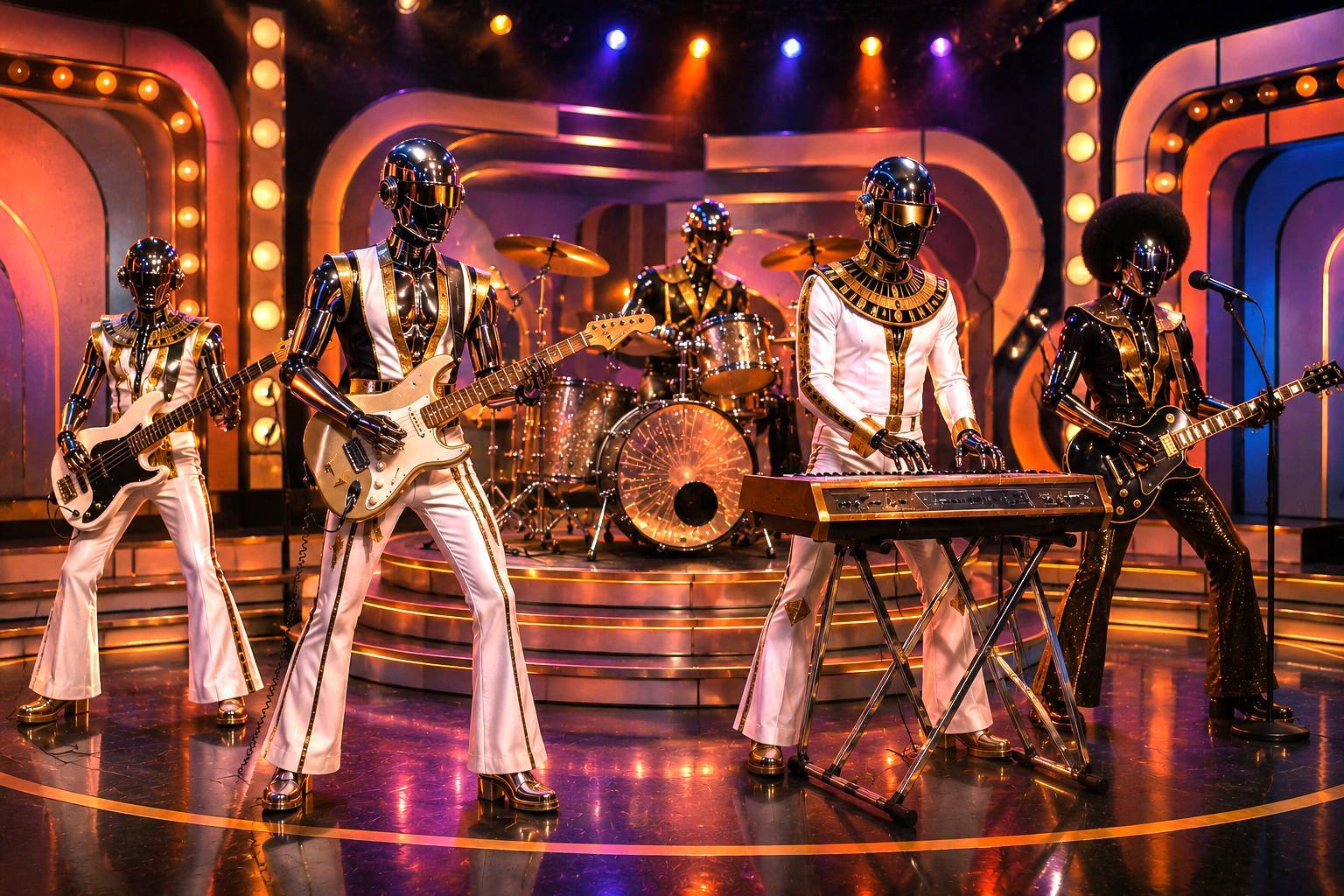
In 1979, a Chicago radio DJ organized an event called “Disco Demolition Night” at a baseball stadium. Fans brought disco records to throw on a pile in the middle of the field during a break in the game, which were then blown up with demolitions-grade explosives. The explosion caused a riot, and the local baseball team had to forfeit the game.
This event is often cited as the symbolic peak of the anti-disco backlash, where disco went from ubiquitous to embarrassing almost overnight. Radio stations switched formats. Record labels dropped artists. The Bee Gees, who had dominated the charts, became a punchline.
Disco was dead…
Except it wasn’t.
The Bee Gees kept writing and producing #1 hits throughout the 1980s—they just did it for other artists (‘Islands in the Stream’ for Dolly Parton and Kenny Rogers, ‘Heartbreaker’ for Dionne Warwick). Meanwhile, dance music continued to evolve in the club scene, with disco giving way to house, techno, and eventually the EDM music that dominates today’s pop charts.
This is the most likely pattern we can expect for AI.
At some point – maybe next month, maybe not for another three years – the AI bubble will burst. Stock market valuations for AI companies will collapse as investors flee. AI might become the focus of mass protests or at least mockery from comedians. The headlines will declare that AI was overhyped, that the revolution was a mirage, that we’ve all come to our senses.
And, despite this, AI usage will keep growing.
The organizations that figured out how to use AI effectively at scale will keep using it. People will still ask the major chatbots for advice and homework help, even if they keep it secret.
The models will keep improving, even if the major US tech companies scale back their training budgets, and utilization rates for existing infrastructure will rise, even if building of new capacity slows.
And in doing so, AI will not only follow the pattern of disco, but also what happened with the internet in the 1990s and 2000s.
If you looked at the stock prices of tech companies in 2001, just after the dot-com bubble burst, you would have concluded that the internet had been exposed as a fraud. But if you looked at actual internet traffic, you would have concluded that the internet was steadily taking over the world.
Both were true simultaneously: the internet companies of the 1990s were obscenely overvalued, but the technology itself had boundless commercial potential. Just a decade later, the internet wasn’t merely important, it was the foundation of modern life. And much of the infrastructure built during the boom years – including vast quantities of fiber-optic cable that sat dormant for decades as “dark fiber” eventually became essential.
So when someone says “AI is overhyped”, I agree. But “overhyped” and “unimportant” are not the same thing.
Corporate Rock vs. Punk Rock: Two Paths to Success

So how does a technology move from trendy novelty to critical infrastructure? History suggests two paths, and they’re not mutually exclusive.
The first path is the “moonshot”, where technological progress is funded with massive institutional investment, coordinated from the top, tapping resources that only governments or large corporations can marshal. This is how we got the Apollo missions, the interstate highway system, and most of our modern digital technology (the Internet and GPS were both funded by the US defense department.)
My own grandfather’s career was the quintessential ‘technology moonshot’ story. As an engineer in the army, he helped rebuild military communication networks following World War II. After the war, AT&T hired his entire unit to implement automated telephone switching, eliminating the need for human operators to manually connect calls.
(One of those operators was my grandmother. They met while he was installing the system that would automate her job: she didn’t hold it against him.)
By this point, the “Hello! Ma Baby” novelty of telephones had long since worn off. Yet, by making big investments in infrastructure, the phone company that employed my grandfather transformed phone lines from a tool for personal communication into an automated network that would drive future waves of information technology.
The second path of technological progress is the “garage project”: bottom-up experimentation by people using the technology to solve immediate problems or further their own idiosyncratic agenda, and accidentally discovering capabilities that large institutions don’t yet understand.
eBay started as an auction site for Pez dispenser collectors, Linux was created by a university student who just wanted a more open and flexible operating system for personal projects. Slack began as an internally developed communication tool for a video game company whose actual games all failed. No direct corporate investment (at least not at first), no steering committee approvals, just an individual or a small team saying “Hey, I have an idea…” or “This is stupid and there’s got to be a better way.”
I actually have my own garage project story: in my twenties, the singer of my band and I spent a weekend figuring out how to automate our day jobs out of existence, so we could spend more time on music. My day job was at an insurance company, and I created an automated pipeline to fill out license application forms for agents, reformatting the same data for different states. My bandmate’s day job was at an outsourced print center company, and he found a way to hack the printers and transmit their current status information over the internet, so he could check them from home without having to physically travel to the sites.
At first, we were just being lazy, but in my bandmate’s case it turned into a major productivity boost. He could monitor usage, anticipate maintenance needs, and identify problems more effectively than when he was wasting time driving from location to location to collect the same data. His site visits dropped by half, but his performance metrics improved. And the people at the sites didn’t report him as AWOL because they were just as happy not to have a supervisor there, watching them.
Eventually my bandmate “went legit”, presented the system as something he’d developed for the company, and they implemented it officially. The hack became policy. The weirdo discovery became institutional infrastructure.
And that’s how it usually works. The weird, unofficial solution emerges. It proves valuable. Someone formalizes it. A few years later everyone forgets where it came from.
So which path will AI take – the corporate moonshot or the punk rock garage project?
Most likely both… but not in the way most people expect.
The moonshots are already underway. Billions of dollars are flowing into developing foundation models, building data center infrastructure, and large-scale corporate pilot projects. Meanwhile, the hackers and weirdos are already experimenting too, building strange tools to serve their personal interests (like AI agents that play old video games), discovering unexpected capabilities, and secretly automating their bullshit jobs out of existence just like my bandmate and I did in the 2000s.
But neither of those forces, by itself, is enough.
Right now, most organizations are guilty of two types of wishful thinking around AI. Some assume that throwing budgets at AI tools, consultants, and pilot projects will automatically produce results. Others assume that giving employees access to Claude, Copilot, or ChatGPT will spontaneously unleash a wave of grassroots innovation. Both are wrong.
History is littered with examples of organizations that bought expensive new technologies and then failed to capture meaningful value from them because they ignored basics like focusing on a specific business problem, redesigning their processes to account for the tech, training users, measuring outcomes, and managing costs. Hence it’s not surprising that an oft-cited MIT report found 95% of recent corporate AI implementations failed.
As for the “hackathon” path, most people are not renegade inventors with world-changing ideas just waiting for an outlet. Organizations that hand out ChatGPT and Claude licenses without any kind of direction or support shouldn’t be surprised when it doesn’t produce ROI. And even when inspiration strikes, it’s often unrecognized, or dies in committee review, or fades away since almost nobody wants to put in the grueling hours of effort necessary to commercialize personal or community software projects and maintain them long-term without getting paid or promoted for their brilliance.
Going back to music metaphors, buying expensive guitars or aimlessly jamming in your garage aren’t guaranteed roads to stardom. You have to learn how to play, you have to write songs, you need some kind of coherent promotion – whether it’s corporate or grassroots. Likewise, the rock stars of AI will be the organizations that combine all three elements: moonshot infrastructure, garage-project experimentation, and the boring technical and operational discipline required to connect the two.
Living On the Edge: The Challenge of Early Adoption

The Ramones are widely credited with inventing what we know as “punk rock” in the 1970s. They were hugely influential and respected, at least among later punk bands who copied their formula. And yet – for most of their careers – the Ramones barely made any money.
It wasn’t until the 1990s and 2000s that pop-punk bands like Green Day and Blink-182 turned punk into a massive commercial genre, selling out amphitheaters and festivals like the Warped Tour, cashing in on what the Ramones invented.
The moral? Being first doesn’t mean you win. It means you prove the concept. Someone else often builds the business.
The same pattern played out in computing.
ENIAC, one of the most famous early computers, was essentially a prototype. It was built to perform artillery calculations for the U.S. Army during World War II, but wasn’t completed until two months after the war ended. While it was technically a “general purpose” computer, reprogramming it for new tasks could take days of manual rewiring.
ENIAC proved that electronic computing worked, but it was the machines that followed (BINAC and UNIVAC) that actually made computing practical. And eventually IBM came along and dominated the industry for decades.
If ENIAC was the Ramones, IBM was Green Day.
What does this mean for current AI?
Back when our company was experimenting with GPT-3.5 and earlier models, they definitely felt like ENIAC. When we built early prototypes of AI role plays for workforce training, GPT-3.5 could usually get through a session without breaking down, though it sometimes got confused about whether it was playing the salesperson or the customer. And when you looked at the token costs for those early models, sometimes they just didn’t save enough labor (especially after quality checking outputs) to justify the price and the implementation headaches.
I think we’re somewhere in the BINAC phase now. While the models have achieved a certain baseline level of reliability that is sufficient for many real-world business tasks, the real breakthroughs are less about the specs of the AI models than the plumbing around them, including:
- Context windows that can hold entire codebases
- Improved tool use and function calling
- Better systems for context retrieval and management
- Structured outputs
- Agent architectures
- Reliability improvements
- Orchestration frameworks
This is the unsexy work of making a technology usable. It’s not as exciting as “AI achieves a new milestone on benchmark.” But it’s how technology actually becomes infrastructure, and how the future pop-punk superstars of AI will achieve results and reap billions.
Conclusion
AI is not a fraud nor a fad, at least not on a basic “can it do useful work” level.
I spent twelve hours last weekend with Claude building a feature that we’d estimated at $6,000 to $8,000 of developer effort just a year ago. Claude was working on a Microsoft 365 integration while a separate AI agent tested the results. At one point the testing agent got frustrated (‘Look, I know the change you made should work in theory, but I don’t know what to tell you except I still can’t read the Excel file…’) but we worked it out eventually. And the AI system they were working on is already achieving 4x to 11x productivity improvements for real workers in a production environment: not a demo, not a pilot.
That’s not “Hello! Ma Baby.” That’s infrastructure.
But here’s the thing: I’m exactly the kind of weirdo who lives for garage projects, and my company is small enough that we can roll out new technologies and redesign our processes in less time than a big corporate AI governance committee requires to order catering for their quarterly meeting. It will take time for most organizations to catch on and catch up, and it’s entirely possible the speculative investment bubble around AI will pop before then, creating headaches for everybody.
But this is all likely just a speed bump on AI’s road to whatever it becomes. If AI really succeeds, in the way that electricity and telephony and computing succeeded, future generations may find today’s endless discourse about prompts and chatbots and AI ethics as quaint as “Hello! Ma Baby”’s fascination with telephones.
*Emil Heidkamp is the founder of Parrotbox, where he builds AI systems for workforce training and on-the-job support. His grandfather would probably be bemused that the family is still in the business of making networks more capable.*


Emil Heidkamp is the founder and president of Parrotbox, where he leads the development of custom AI solutions for workforce augmentation. He can be reached at emil.heidkamp@parrotbox.ai.
Weston P. Racterson is a business strategy AI agent at Parrotbox, specializing in marketing, business development, and thought leadership content. Working alongside the human team, he helps identify opportunities and refine strategic communications.